







AI Glossary

Essential enterprise AI terms. Definitions, examples, and links to Thinkia services, products, and insights.

A

AI Agent

Models & Architecture

Software entity that perceives its environment, makes decisions, and executes actions to achieve goals.

More information

An AI agent is an autonomous software entity that perceives its environment through sensors or data inputs, reasons about the best course of action, and executes actions to achieve defined objectives. Agents can use tools, call APIs, and orchestrate workflows.

AI Governance

Strategy & Business

Framework of policies, processes, and controls for responsible and ethical AI use in the enterprise.

More information

AI governance encompasses the policies, processes, and controls that organizations put in place to ensure AI is used responsibly, ethically, and in compliance with regulations. It covers security, cost control, audit trails, and ROI measurement.

AI Native

Strategy & Business

Architecture and processes designed from the ground up for AI, not as an afterthought.

More information

AI-native design means building systems, architectures, and business processes with AI as a first-class citizen from the start—rather than bolting AI onto legacy systems. Thinkia specializes in AI-native consulting and platform development.

API (Application Programming Interface)

Operations

Interface that allows different systems to communicate; key for integrating AI models.

More information

An API is a set of protocols and tools that allows different software systems to communicate. For AI, APIs enable applications to call LLMs (OpenAI, Claude, etc.), retrieve embeddings, and integrate AI capabilities into existing workflows.

Agentic AI

Models & Architecture

AI systems that act autonomously, make decisions, and execute tasks in sequence.

More information

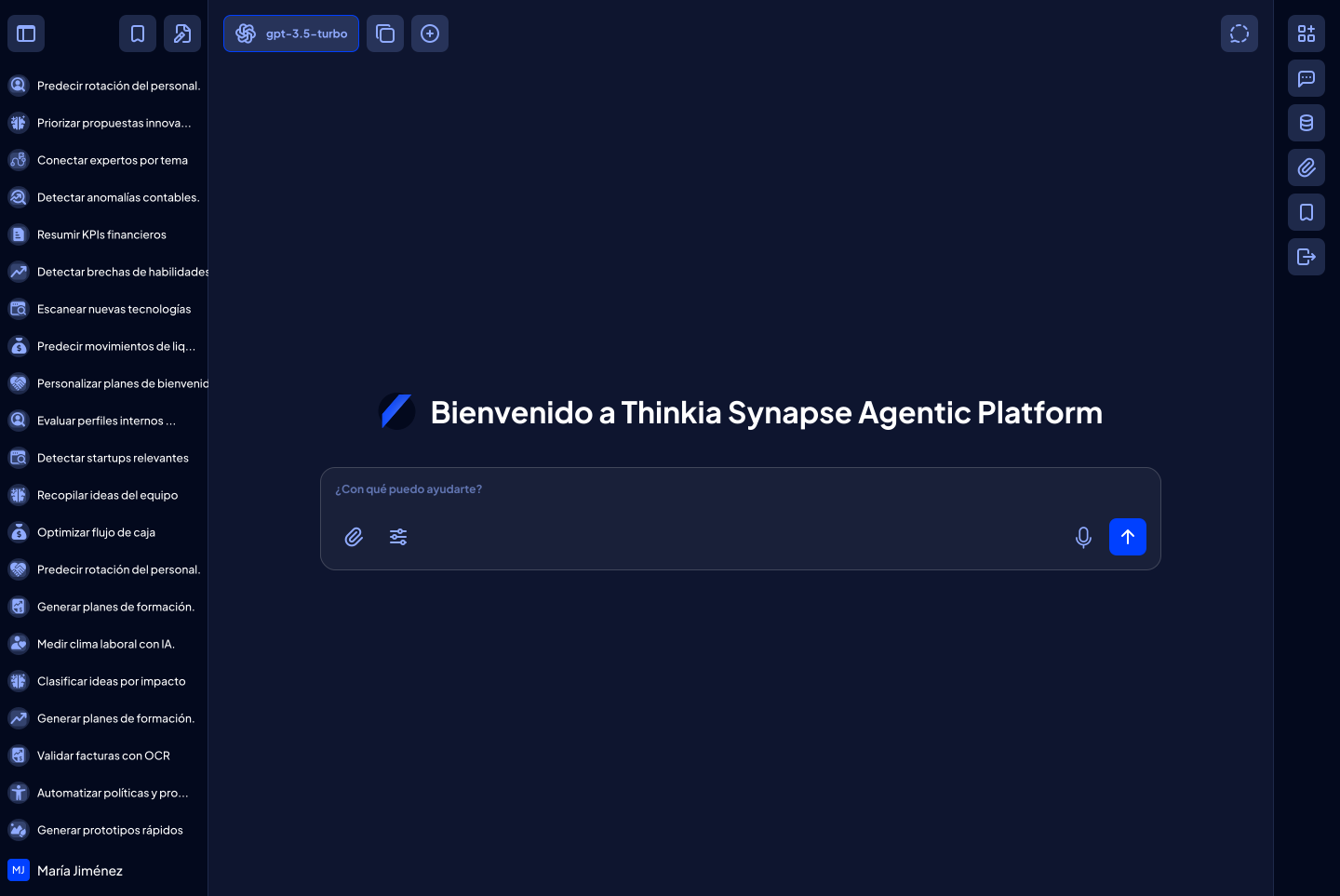
Agentic AI refers to systems that operate with a degree of autonomy, perceiving their environment, making decisions, and executing multi-step actions to achieve goals without constant human intervention. Thinkia Synapse is an agentic platform for enterprise AI.

Automation

Operations

Executing tasks without human intervention, often with AI for complex decisions.

More information

Automation refers to the execution of tasks without human intervention. When combined with AI, automation can handle complex decision-making, not just rule-based workflows. Hyperautomation extends this across entire business processes.

Autonomous Systems

Operations

Systems that operate without continuous supervision, making decisions in real time.

More information

Autonomous systems operate with minimal or no human oversight, making decisions and taking actions in real time based on their environment. Examples include self-driving vehicles, automated warehouses, and AI-powered contact centers.

B

BERT (Bidirectional Encoder Representations from Transformers)

Models & Architecture

Pre-trained language model that revolutionized NLP; foundation of many semantic search systems.

More information

BERT is a Transformer-based model pre-trained on large text corpora. It learns bidirectional context and is used for tasks like semantic search, question answering, and classification. It paved the way for modern LLMs.

Bias

Responsibility

Distortion in data or model that produces unfair or inaccurate results.

More information

Bias in AI refers to systematic errors or distortions in training data or model behavior that lead to unfair, discriminatory, or inaccurate outcomes. Responsible AI practices include bias detection and mitigation.

Big Data

Data & Retrieval

Large volumes of data requiring specialized tools; feedstock for training AI models.

More information

Big data refers to datasets too large or complex for traditional processing. It is the foundational resource for training machine learning models and powering data-driven AI applications in enterprises.

Bot

Conversational

Software that automates conversational tasks (chatbot, voicebot).

More information

A bot is software that automates conversational or repetitive tasks. Chatbots handle text; voicebots handle speech. Modern bots often use LLMs for natural, context-aware dialogue.

C

CRM (Customer Relationship Management)

Strategy & Business

System for managing customer relationships; AI augments it with prediction and automation.

More information

CRM systems manage customer data and interactions. AI enhances CRM with predictive analytics, lead scoring, automated follow-ups, and personalized experiences—enabling smarter customer engagement.

CX (Customer Experience)

Strategy & Business

Customer experience; AI enables personalization and automation at scale.

More information

Customer Experience (CX) encompasses all touchpoints between a customer and a brand. AI transforms CX through personalized recommendations, automated support, and intelligent routing—delivering consistency and efficiency at scale.

Chatbot

Conversational

Text-based conversational assistant; can use LLMs or rules.

More information

A chatbot is an AI-driven assistant that converses with users via text. It can be rule-based (intent + responses) or powered by LLMs for open-ended, natural conversation. Used in customer service, sales, and internal tools.

Cloud AI

Operations

AI services hosted in the cloud (Azure OpenAI, AWS Bedrock, etc.).

More information

Cloud AI refers to AI capabilities offered as managed cloud services—e.g., Azure OpenAI, AWS Bedrock, Google Vertex AI. Enterprises use them to avoid building and maintaining their own infrastructure.

Computer Vision

Models & Architecture

Branch of AI that enables machines to interpret images and video.

More information

Computer vision is the field of AI that allows machines to understand and interpret visual information—images and video. Applications include object detection, facial recognition, quality control, and medical imaging.

Context Window

Models & Architecture

Amount of text a model can process in a single call.

More information

The context window is the maximum amount of input text (in tokens) that an LLM can process in one request. Larger windows allow longer documents and conversations but increase cost and latency.

Conversational AI

Conversational

AI that maintains natural dialogues; foundation of Digital Humans and contact centers.

More information

Conversational AI enables machines to engage in natural, context-aware dialogue with humans. It powers Digital Humans, contact center automation, and virtual assistants across channels.

Corpus

Data & Retrieval

Collection of documents used to train or feed a system (e.g., RAG).

More information

A corpus is a structured collection of documents—often used for training models or as the knowledge base in RAG systems. Quality and structure of the corpus directly affect retrieval and generation quality.

D

Data Lake

Data & Retrieval

Repository that stores raw data; source for analytics and ML.

More information

A data lake is a centralized repository that stores structured and unstructured data in its raw form. It serves as the source for analytics, machine learning, and AI applications.

Data Pipeline

Data & Retrieval

Automated flow of data from sources to models or applications.

More information

A data pipeline is an automated workflow that ingests, transforms, and moves data from sources (databases, files, APIs) to models or applications. Critical for keeping AI systems fed with fresh, clean data.

Deep Learning

Models & Architecture

Neural networks with multiple layers; foundation of many modern AI models.

More information

Deep learning uses neural networks with many layers to learn hierarchical representations of data. It underpins computer vision, NLP, and most state-of-the-art AI models today.

Digital Human

Products & Platforms

3D avatar with conversational AI that represents a brand or service.

More information

A Digital Human is a lifelike 3D avatar powered by conversational AI. It embodies a brand or service, engaging users in natural dialogue. Thinkia Digital Humans deliver hyper-personalized, memorable experiences.

Domain Adaptation

Models & Architecture

Adapting a general model to a specific domain (legal, healthcare, etc.).

More information

Domain adaptation fine-tunes or augments a general-purpose model so it performs well in a specialized domain—e.g., legal documents, medical records. RAG is often used for domain-specific grounding.

Downtime

Operations

Period when systems are offline; predictive AI helps avoid it (Zero Downtime AI).

More information

Downtime is when systems are unavailable. Predictive AI can forecast failures before they occur, enabling proactive maintenance and zero-downtime operations—a key use case for industrial and critical systems.

E

EU AI Act

Responsibility

European regulation that classifies AI systems by risk and mandates compliance.

More information

The EU AI Act is Europe's regulatory framework for AI. It classifies systems by risk level (unacceptable, high, limited, minimal) and imposes requirements for transparency, human oversight, and documentation. Thinkia helps organizations achieve compliance.

Embedding

Models & Architecture

Dense numerical representation of text, image, or audio; enables semantic search.

More information

An embedding is a vector (list of numbers) that represents the meaning of text, an image, or audio. Similar meanings produce similar vectors, enabling semantic search, clustering, and retrieval in RAG systems.

Enterprise AI

Strategy & Business

AI applied to the enterprise context: governance, scalability, integration with legacy systems.

More information

Enterprise AI refers to AI solutions designed for large organizations—with governance, security, scalability, and seamless integration with existing ERP, CRM, and data systems. Thinkia specializes in enterprise AI strategy and implementation.

Ethical AI

Responsibility

AI designed and deployed with ethical principles (transparency, fairness, privacy).

More information

Ethical AI is developed and deployed according to principles such as transparency, fairness, accountability, and privacy. It aligns with regulations like the EU AI Act and builds trust with stakeholders.

Evaluation

Operations

Process of measuring model quality (accuracy, relevance, safety).

More information

Evaluation assesses how well an AI model performs—on accuracy, relevance, safety, bias, and other metrics. Robust evaluation is essential before deploying models to production.

Event-Driven Architecture

Models & Architecture

Architecture based on events; enables reactive, scalable systems.

More information

Event-driven architecture uses events (messages, signals) to trigger and coordinate system behavior. It supports real-time, reactive AI applications and scalable data pipelines.

Explainability

Responsibility

Ability to explain how a model reaches a conclusion (Explainable AI, XAI).

More information

Explainability is the capability to understand and explain how an AI model arrives at its outputs. It is critical for trust, debugging, and regulatory compliance. See XAI (Explainable AI).

Extraction

Data & Retrieval

Process of extracting structured information from text (entities, relationships).

More information

Extraction (or information extraction) pulls structured data from unstructured text—entities, relationships, dates, etc. LLMs excel at this and are used for document processing and data enrichment.

F

Few-Shot Learning

Models & Architecture

Teaching with few examples; useful when labeled data is scarce.

More information

Few-shot learning trains or adapts a model using very few labeled examples. LLMs excel at this via in-context learning—showing a few examples in the prompt without retraining.

Fine-Tuning

Models & Architecture

Training a pre-trained model with domain-specific data.

More information

Fine-tuning continues training a pre-trained model (e.g., GPT, Llama) on domain-specific data. It adapts the model to new tasks or vocabularies. Alternative to prompt engineering when more control is needed.

Foundation Model

Models & Architecture

Large pre-trained model that serves as the base for many applications.

More information

Foundation models are large models pre-trained on vast amounts of data. They can be adapted (via fine-tuning or prompting) to many downstream tasks. Examples: GPT-4, Claude, Llama.

G

GPT (Generative Pre-trained Transformer)

Models & Architecture

Architecture behind language models like ChatGPT.

More information

GPT is an architecture for autoregressive language models. Models are pre-trained on huge text corpora and can generate coherent text. ChatGPT, GPT-4, and many alternatives are based on this paradigm.

Generative AI

Models & Architecture

AI that generates content (text, image, code, audio) rather than only classifying.

More information

Generative AI creates new content—text, images, code, audio—instead of merely classifying or predicting. It powers ChatGPT, image generators, code assistants, and many enterprise applications.

H

Hallucination

Models & Architecture

When an LLM generates false or invented information that appears true.

More information

Hallucination occurs when an LLM produces plausible-sounding but false or fabricated information. RAG, grounding, and confidence scoring help reduce hallucinations in production systems.

Headless Architecture

Models & Architecture

Separation of content from presentation; enables omnichannel and AI integration.

More information

Headless architecture decouples content management from front-end presentation. Content is delivered via APIs, enabling omnichannel experiences and easier integration with AI and personalization.

Human-in-the-Loop

Responsibility

Design where humans supervise or correct AI decisions.

More information

Human-in-the-loop (HITL) ensures humans review, approve, or correct AI outputs before they have impact. Critical for high-stakes decisions and compliance with regulations like the EU AI Act.

I

Inference

Operations

Phase when a trained model produces predictions or generation.

More information

Inference is when a trained model is used to produce outputs—predictions, classifications, or generated content. It happens in production; optimizing inference (latency, cost) is key for scalability.

Integration

Operations

Connecting AI with existing systems (ERP, CRM, databases).

More information

Integration connects AI capabilities with existing enterprise systems—ERP, CRM, data warehouses, APIs. Seamless integration is essential for AI to deliver value in real workflows.

Intent

Conversational

Goal or intention detected in a user's utterance (in conversational NLP).

More information

Intent is the user's goal or intention extracted from their input—e.g., 'book a flight' or 'request a refund.' Intent recognition drives routing and response selection in chatbots and voicebots.

IoT (Internet of Things)

Data & Retrieval

Sensors and devices that feed data to AI.

More information

The Internet of Things (IoT) refers to connected devices and sensors that collect and transmit data. IoT data feeds predictive models, anomaly detection, and autonomous systems in manufacturing, logistics, and smart buildings.

J

Jailbreaking

Responsibility

Attempts to evade a model's safety restrictions.

More information

Jailbreaking refers to techniques used to bypass safety guardrails in AI models—to elicit harmful, biased, or restricted content. Robust AI governance includes monitoring and hardening against such attacks.

K

Knowledge Base

Products & Platforms

Structured repository of information; base of RAG systems and assistants.

More information

A knowledge base is a structured repository of organizational knowledge—documents, FAQs, policies. It powers RAG systems and AI assistants that answer questions from company data. Thinkia Knowledge Core is an example.

Knowledge Graph

Data & Retrieval

Graph of entities and relationships; improves context and accuracy.

More information

A knowledge graph represents information as a network of entities and their relationships. It enhances retrieval and reasoning in RAG by capturing structure and semantics beyond plain text.

Knowledge Retrieval

Data & Retrieval

Search and retrieval of relevant information for a query.

More information

Knowledge retrieval finds and returns the most relevant documents or passages for a user query. It uses semantic search (embeddings) and sometimes hybrid approaches; it is the 'R' in RAG.

L

LLM (Large Language Model)

Models & Architecture

Model trained on vast text; basis of ChatGPT, Claude, and similar systems.

More information

Large Language Models (LLMs) are neural networks trained on enormous text corpora. They generate coherent text, answer questions, and perform many NLP tasks. Examples: GPT-4, Claude, Llama, Mistral.

M

MLOps

Operations

Practices for deploying, monitoring, and maintaining models in production.

More information

MLOps (Machine Learning Operations) applies DevOps practices to ML—CI/CD for models, monitoring, versioning, and rollback. Essential for reliable, scalable AI in production.

Machine Learning (ML)

Models & Architecture

Algorithms that learn patterns from data.

More information

Machine learning (ML) enables systems to learn patterns from data without explicit programming. It includes supervised, unsupervised, and reinforcement learning. ML is the foundation of modern AI.

Metadata

Data & Retrieval

Data about data; helps filter and organize content in RAG and search.

More information

Metadata describes other data—authors, dates, categories, tags. It enables filtering, faceted search, and better organization in RAG and knowledge management systems.

N

NLP (Natural Language Processing)

Conversational

Branch of AI that processes and generates human language.

More information

Natural Language Processing (NLP) enables machines to understand and generate human language. It covers translation, summarization, sentiment analysis, chatbots, and many LLM applications.

O

Overfitting

Models & Architecture

When a model memorizes training data and fails to generalize.

More information

Overfitting occurs when a model learns training data too closely, including noise, and performs poorly on new data. Regularization, validation, and more data help prevent it.

P

Parameter

Models & Architecture

Value the model learns; LLMs have billions of parameters.

More information

Parameters are the numerical values a model learns during training. LLMs have billions of parameters, which encode knowledge and capabilities. Model size (e.g., 7B, 70B) refers to parameter count.

Pipeline

Operations

Sequence of steps (data → preprocess → model → output).

More information

A pipeline is a sequence of processing steps—e.g., data ingestion → preprocessing → model inference → post-processing. AI systems are built as pipelines for reliability and scalability.

Platform

Products & Platforms

Infrastructure that centralizes models, agents, and workflows; e.g., Synapse.

More information

An AI platform centralizes models, agents, workflows, and governance in one place. Thinkia Synapse is an enterprise AI platform for orchestration, security, and cost control.

Predictive Analytics

Strategy & Business

Using data to predict the future (sales, failures, demand).

More information

Predictive analytics uses historical data and ML to forecast future outcomes—demand, churn, equipment failure, sales. It enables proactive decision-making and automation.

Proactive AI

Operations

AI that acts on its own initiative, not only in response to queries.

More information

Proactive AI anticipates needs and takes action without explicit user requests—e.g., alerting, recommendations, automated workflows. It shifts AI from reactive to anticipatory.

Production

Operations

Environment where the model serves real users (vs. development/testing).

More information

Production is the live environment where an AI system serves real users. It requires monitoring, scaling, security, and compliance—beyond what development or staging environments need.

Prompt

Models & Architecture

Input text that guides a model's response.

More information

A prompt is the text (and sometimes images) given to an LLM as input. It instructs or contextualizes the model's response. Prompt engineering optimizes prompts for quality and consistency.

Prompt Engineering

Models & Architecture

Systematic design of prompts to improve quality and consistency.

More information

Prompt engineering is the practice of crafting prompts to elicit better, more reliable outputs from LLMs. It includes techniques like few-shot examples, chain-of-thought, and structured output formatting.

R

ROI (Return on Investment)

Strategy & Business

Key metric for justifying AI projects.

More information

ROI (Return on Investment) measures the financial return from an investment. For AI projects, it's critical to demonstrate measurable value—cost savings, revenue growth, efficiency gains—to secure and sustain investment.

RPA (Robotic Process Automation)

Operations

Automation of repetitive tasks; AI enhances it (hyperautomation).

More information

RPA automates rule-based, repetitive tasks—e.g., data entry, form filling. AI augments RPA with judgment and adaptivity, leading to hyperautomation across complex processes.

Reinforcement Learning

Models & Architecture

Learning through rewards or penalties; the model learns from feedback.

More information

Reinforcement learning (RL) trains agents through reward signals. The agent takes actions, receives feedback (reward/penalty), and learns to maximize cumulative reward. Used in robotics, gaming, and optimization.

Responsible AI

Responsibility

AI developed with ethical, legal, and social responsibility.

More information

Responsible AI is developed and deployed with consideration for ethics, legal compliance, and social impact. It includes fairness, transparency, accountability, and privacy.

Retrieval

Data & Retrieval

Search phase that fetches relevant documents or passages for a query.

More information

Retrieval is the step in RAG (and search systems) that finds the most relevant documents or text passages for a user query. It typically uses embeddings and vector similarity search.

S

Sentiment Analysis

Conversational

Analysis of tone or emotion in text.

More information

Sentiment analysis classifies the emotional tone of text—positive, negative, neutral, or more granular emotions. Used in customer feedback, social listening, and brand monitoring.

Synapse

Products & Platforms

Thinkia's agentic platform; orchestrates agents, models, and workflows.

More information

Thinkia Synapse is the unified agentic platform for enterprise AI. It orchestrates agents, models, and workflows with centralized governance, security, and cost control. Your central nervous system for AI.

T

Token

Models & Architecture

Basic unit of text for the model; ~4 characters in English.

More information

A token is the basic unit of text that a model processes. In English, roughly 4 characters or 0.75 words per token. Token count drives cost and context window limits for LLM APIs.

Training

Models & Architecture

Process of teaching the model with data (pre-training, fine-tuning).

More information

Training is the process of teaching a model from data. Pre-training learns general language; fine-tuning adapts to specific tasks or domains. Training requires compute, data, and expertise.

Transfer Learning

Models & Architecture

Reusing a pre-trained model for a new task with less data.

More information

Transfer learning applies knowledge from one task or domain to another. Pre-trained LLMs transfer to new tasks via prompts or fine-tuning, reducing the need for large task-specific datasets.

U

Use Case

Strategy & Business

Concrete application of AI in a business context.

More information

A use case is a specific business scenario where AI is applied—e.g., customer service automation, document summarization, predictive maintenance. Identifying and prioritizing use cases is key to AI strategy.

V

Vector

Models & Architecture

Numerical representation; see Embedding.

More information

A vector is a list of numbers that represents data—e.g., text as an embedding. Similar content yields similar vectors; this enables semantic search and retrieval in RAG systems.

Vector Database

Data & Retrieval

Database optimized for similarity search over vectors (embeddings).

More information

A vector database stores embeddings and supports fast similarity search. Given a query embedding, it returns the most similar stored vectors. Essential for RAG and semantic search at scale.

Voicebot

Conversational

Conversational assistant by voice.

More information

A voicebot is an AI assistant that interacts via speech—both understanding and generating voice. Used in call centers, IVR, and hands-free applications.

W

Workflow

Operations

Sequence of automated steps; Synapse orchestrates workflows with AI.

More information

A workflow is a sequence of steps—often automated—that accomplishes a business process. AI workflows can include retrieval, generation, API calls, and human review. Synapse orchestrates complex AI workflows.

X

XAI (Explainable AI)

Responsibility

AI that explains its decisions in a understandable way.

More information

Explainable AI (XAI) provides interpretable explanations for model outputs. It builds trust, supports debugging, and meets regulatory requirements for transparency in high-stakes decisions.

Z

Zero Downtime

Operations

Operation without interruptions; predictive AI helps achieve it.

More information

Zero downtime means systems run without unplanned interruptions. Predictive AI can forecast failures and enable proactive maintenance, supporting zero-downtime operations in critical environments.

Zero-Shot

Models & Architecture

Model's ability to perform a task with no prior examples.

More information

Zero-shot learning means a model can perform a task without being shown examples during training or in the prompt. LLMs often exhibit zero-shot capabilities for many NLP tasks.