






1 · Developer Experience
Agentic IDEs, CLIs — Buy


/ Thinkia · Pulse /
Pulse runs AI-SDLC end to end—from structured intent to auditable deploy. For teams already generating code with AI who need to know what merges to production.
More teams ship with AI assistants. The gap is not speed—it is defensibility before merge: lineage, sign-off, and compliance your CTO can stand behind.
Nobody can say which LLM generated a module, with which prompt, or what changed between iterations.
Code reaches production without a signed spec or a named owner for the risk the organization accepted.
EU AI Act and internal policy checks run late—or not at all—because tooling was built for velocity, not audit.
Tests pass, but reviewers cannot prove they understood what they approved before merge.
Cursor, Copilot, v0, and similar tools run outside the corporate gateway: no DLP, no metering, no unified audit trail.
Leadership is pushed to choose between shipping fast and defending what shipped—when both should be non-negotiable.
Platform
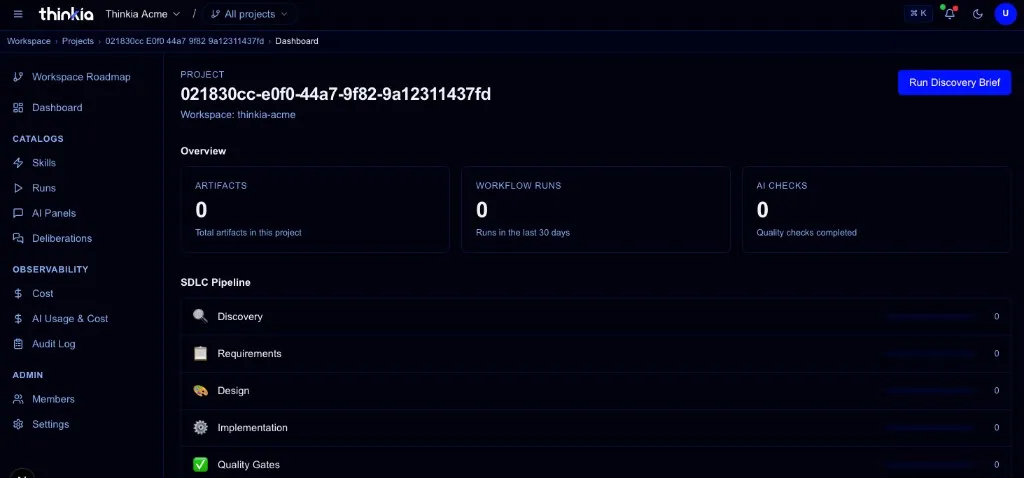
Every feature you ship carries full lineage: what was specified, who signed, which model generated each story, which tests covered which scenarios, which dashboards were published, and which Production Context feeds the next iteration.
Architecture
You do not deploy everything on day one. Pulse supports adoption in stages—we start with the layers that move the needle most in your context.
Agentic IDEs, CLIs — Buy
Specs, Production Context Store — Build with Pulse
MCP servers, Skill Registry — Pulse + extend
Isolated containers — Configure with Pulse
LLM Gateway: DLP, routing, audit — Pulse integrates yours or Thinkia’s
CI/CD + spec gates + AI-augmented deploy — Extend what you have
Cloud, GPU, Vector DB — You already have it
Not a big-bang rollout. Pulse meets you where your stack is and grows governance with your teams.
Differentiators
Concrete capabilities—not positioning slogans.
Three files per feature—what, how, UI—with five mandatory signatures before code is generated. No generation without a contract.
Every unit of code has its bill of materials: model, tokens, prompts, manual edits, coverage. Audit trail starts built in.
Distributed detection of contradictions, unvalidated assumptions, and poorly scoped work. Issues surface in F2—where fixing them costs a fraction of later rework.
Five critical transitions validated—from RFP to story. Nothing drops without someone signing that it was dropped on purpose.
DLP, routing by automation zone, audit trail, metering, multi-provider. Every model call goes through here. Non-negotiable in regulated environments.
Pulse does not lock your team in. If you move to Claude Code, Cursor, or your own orchestrator tomorrow, the methodology travels with you. Skills stay standard.

Methodology
A cross-cutting architecture track—Constitution, Application Architecture, Patterns—evolves in parallel and feeds every generation.
Path A (RFP) or Path B (Discovery). Pulse distills the context.
Capability briefs, evidence-backed discovery, time-boxed spikes.
`.spec.md` + `.design.md` + `.ui-spec.md`. Five mandatory signatures.
Agents in an isolated sandbox. Traceability per story.
Comprehension metric as a gate. No understanding, no merge.
Deploy-as-Spec, Change Impact, intelligent rollout with auto-rollback.
Outcomes
How Pulse improves software work in large organisations—from signed intent and governed AI to releases you can explain under audit.
Aligned
Intent before code
Golden Specs replace vague tickets—product, engineering, and compliance agree on what “done” means before agents generate a line.
Governed
Corporate AI only
Generation runs through your LLM Gateway and sandboxes—traceable tokens, DLP, and policy instead of shadow prompts on personal keys.
Traceable
Every merge explained
AI-BOM ties each story to models, tests, and sign-offs—what merged is reconstructable for review, ops, and regulators.
Faster
Less rework in the SDLC
Comprehension gates and structured handoffs cut bounce between discovery, build, and QA—the pipeline moves when intent stays clear.
Safer
Risk scored before prod
Change Impact and Deploy-as-Spec surface blast radius early—intelligent rollout and rollback with context, not firefighting after users report it.
Compliant
Evidence with the release
EU AI Act artefacts and Production Context ship in the same train as the build—audit readiness without a separate documentation sprint.
Industries
Concrete scenarios—not generic “digital transformation”.
Core refactoring with MiCA/DORA compliance built in. Regulatory traceability per release without extra manual effort.
Clinical platforms with high-risk AI Act audit paths. Synthetic data in generation environments. Legal/DPO signature as a gate.
Digital team velocity without losing PCI-DSS governance. Pulse keeps feature delivery pace with automatic audit trail.
ENS, ENI, and CCN-STIC compliance in the flow. Tenders require traceability—Pulse produces it without the team writing it by hand.
Industrial systems with SIL, IEC 62443, and ISA/IEC 62443. Code generation where it applies; human authorship where it must.
Pulse is Thinkia’s AI-native platform for governed corporate software generation. It implements the AI-SDLC methodology end to end: Golden Specs, sandboxed agent generation, comprehension gates, AI-augmented delivery, and granular AI-BOM traceability.
No. Pulse layers governance on your stack: buy or keep your developer experience and foundation infra, build spec and context with Pulse, extend DevSecOps with spec gates. MCP compatibility keeps orchestration portable.
Enterprise AI-SDLC is the methodology; Pulse is the platform that operationalizes it. The playbook and programme structure live on the Enterprise AI-SDLC page; Pulse is where teams run the flow day to day.
Those tools optimize individual speed. Pulse optimizes organizational defensibility: signable specs before generation, corporate LLM Gateway, audit trail per story, and delivery gates tied to comprehension and compliance—not just tokens shipped.
The MVP stage targets Golden Specs from week one with one pilot team. Governed multi-team rollout typically follows in months 1–3; organization-wide delivery patterns in months 3–9, validated by metrics at each stage.
Get started
45 minutes with our AI Engineering Office—context, compliance, and where to start.
Or read the AI-SDLC playbook.